
MENU
Robotic vs Traditional Knee Replacement: What's the Difference?
Author : Dr. Kunal Patel (MBBS, MS (Ortho),Mch, FIJR, FIAS, (HSS-USA and Endoklinic Germany)
Category : Knee
Published Date : July 28, 2026
Table of Contents
Knee replacement techniques have improved over the years, giving patients different options based on their condition and needs. Two commonly discussed approaches are robotic and traditional knee replacement.
While both aim to improve knee movement and quality of life, they differ in areas such as surgical planning, technology used, and the level of assistance available during the procedure. Knowing how each method works can make it easier for patients to have informed conversations about their treatment options.
In this blog, we will explain the differences between robotic and traditional knee replacement in a simple way.
What Is Robotic Knee Replacement?
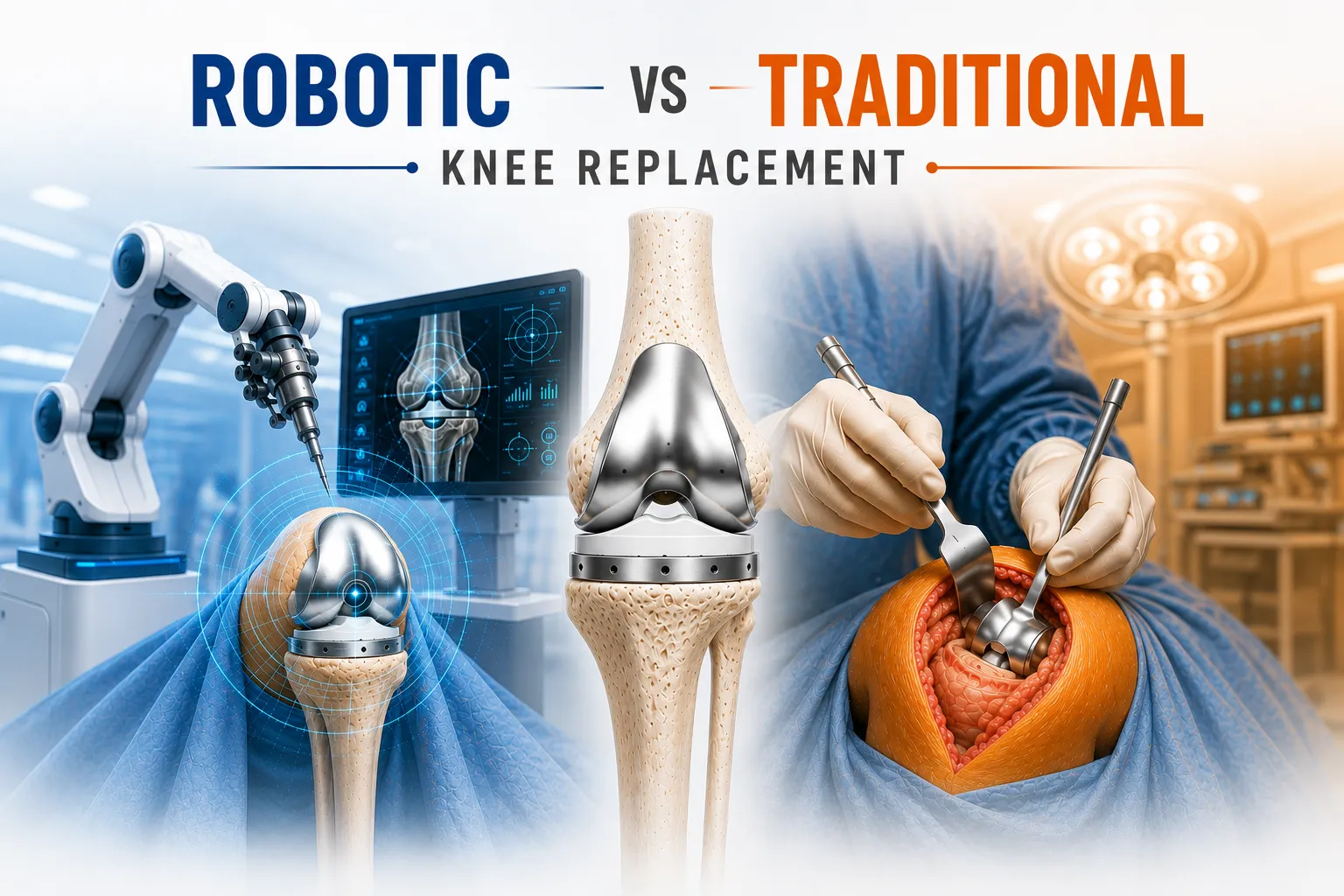
Robotic knee replacement is a surgical technique where a surgeon uses robotic assistance to plan and perform knee replacement with improved precision. The robotic system helps create a detailed view of the patient’s knee, allowing the surgeon to understand the joint structure and plan the procedure more accurately. During surgery, the technology assists with controlled movements and accurate placement of the knee implant based on the patient’s anatomy.
However, the robot does not perform the surgery independently; the surgeon remains in complete control throughout the procedure. Robotic assistance is one of the latest advances in knee replacement technology that combines medical expertise with advanced tools to support personalized surgical care.
What Is Traditional Knee Replacement?
Traditional knee replacement is a surgical method where the surgeon replaces the affected parts of the knee joint using conventional surgical techniques and instruments. In this approach, the surgeon carefully evaluates the knee, removes the worn portions of the joint, and positions an artificial implant to support smoother movement.
The procedure is performed based on the surgeon’s planning, skill, and understanding of the patient’s knee structure. Traditional knee replacement has been widely used for many years and continues to help patients improve mobility and perform daily activities with better comfort. This method is usually considered when ongoing knee pain and movement difficulties continue to affect everyday activities despite other treatment approaches.
Key Differences Between Robotic and Regular Knee Replacement
Both robotic and traditional knee replacement are performed to improve knee function, but they differ in how the procedure is planned and carried out. Below are the differences:
|
Differences |
Robotic Knee Replacement |
Traditional Knee Replacement |
|
Surgical Planning |
Uses advanced technology to create a detailed surgical plan based on the patient’s knee structure |
Planning is done using standard evaluation methods and the surgeon’s expertise |
|
Precision During Surgery |
Robotic assistance helps the surgeon make controlled adjustments during the procedure |
The surgeon performs the procedure using conventional surgical instruments and techniques |
|
Implant Alignment |
Technology assists in positioning the implant according to the patient’s anatomy |
Implant placement is guided by the surgeon’s measurements, experience, and planning |
|
Recovery Experience |
Accurate planning may support a smoother recovery depending on the patient’s overall condition |
Recovery outcomes depend on factors like surgery, rehabilitation, and individual healing |
|
Long-Term Function |
Designed to support natural knee movement through personalized implant positioning |
Has a long history of helping patients regain movement and daily function |
|
Personalization of Treatment |
Allows more customized planning based on detailed information about the knee |
Treatment decisions are based on clinical assessment and proven surgical methods |
According to a study published on PubMed Central, total knee replacement procedures in India increased by over 2,500% between 2006 and 2019, showing its growing adoption.
Advantages of Robotic Surgery
Robotic knee replacement uses technology to assist surgeons with better planning and accuracy.
- Personalized Planning – Customized according to each patient’s knee structure.
- Precise Implant Placement – Helps position the implant with improved accuracy.
- Better Surgical Guidance – Supports controlled movements during the procedure.
- Detailed Joint Assessment – Provides clearer information for surgical planning.
Disadvantages of Robotic Knee Replacement
Like every surgical approach, robotic knee replacement has a few limitations to consider.
- Higher Cost – Usually more expensive due to advanced technology.
- Limited Availability – Not available in all hospitals and medical centers.
- Requires Expertise – Needs surgeons trained in robotic-assisted systems.
- Technology Requirement – Depends on specialized equipment and setup.
Who Should Consider Robotic Knee Replacement?
Robotic knee replacement may be suitable for:
- Patients who prefer technology-assisted surgical planning.
- People who require a more customized knee replacement approach.
- Individuals with specific knee alignment requirements.
- Those advised robotic surgery after a detailed orthopedic evaluation.
Advantages of Traditional Knee Replacement
Traditional knee replacement is a widely used approach with years of clinical experience and results.
- Established Procedure – Used for many years with reliable outcomes.
- Wide Availability – Offered across many hospitals and orthopedic centers.
- Cost Accessibility – Usually more affordable than robotic-assisted surgery.
- Proven Surgical Approach – Uses well-established techniques performed by surgeons.
Disadvantages of Traditional Knee Replacement
Although traditional knee replacement is effective, patients should understand its limitations.
- Less Technology Support – Does not involve robotic-assisted guidance.
- Manual Planning Process – Depends on surgical evaluation and measurements.
- Limited Digital Customization – May have fewer technology-based planning features.
- Experience Dependent – Results depend on surgical skill and individual factors.
Who Should Consider Traditional Knee Replacement?
Traditional knee replacement may be suitable for:
- Patients looking for a well-established surgical approach.
- People who prefer a widely available knee replacement option.
- Individuals who may not require robotic-assisted planning.
- Those advised traditional surgery after an orthopedic evaluation.
When Should You See a Doctor?
You should consider seeing an orthopedic specialist when knee pain or movement problems continue for more than a few weeks and start affecting your daily routine. Occasional discomfort may improve with rest and lifestyle changes, but ongoing symptoms may need proper evaluation to understand the cause. Difficulty while walking, climbing stairs, sitting down, or performing regular activities can indicate that your knee needs attention.
The best replacement surgeon in Chennai can assess your condition, explain available treatment options, and help determine whether non-surgical care, traditional knee replacement, or robotic knee replacement may be suitable based on your individual needs.
Conclusion
Robotic and traditional knee replacement both have their own advantages, and the right approach depends on factors such as knee condition, lifestyle, and treatment needs. Robotic surgery provides technology-assisted planning and precision, while traditional knee replacement remains a reliable technique with years of clinical use.
Making the right decision starts with understanding your options and receiving proper medical guidance. Dr. Kunal Patel helps patients evaluate their knee concerns and choose a knee replacement approach that matches their individual needs and recovery goals.
FAQ’s
1. What is the main difference between robotic and traditional knee replacement?
The main difference is that robotic knee replacement uses technology-assisted planning and guidance, while traditional knee replacement uses conventional surgical techniques performed by the surgeon.
2. Is robotic knee replacement done completely by a robot?
No, the surgeon performs the procedure while the robotic system supports planning and surgical guidance.
3. How does robotic knee replacement differ from traditional knee replacement?
Robotic surgery uses technology-assisted guidance, while traditional surgery follows conventional surgical techniques.
4. Who can consider robotic knee replacement surgery?
Patients with knee problems affecting movement and daily activities can discuss robotic knee replacement if they want to understand advanced surgical options.
5. What is the recovery time after knee replacement surgery?
Recovery time differs for each patient based on health, surgery type, and rehabilitation progress.
6. Who provides robotic and traditional knee replacement treatment in Chennai?
Dr. Kunal Patel provides evaluation and treatment options for patients considering robotic and traditional knee replacement surgery in Chennai.
7. Do robotic and traditional knee replacements use different implants?
Both methods may use similar implants; the main difference is the surgical technique and planning process.
8. Can knee replacement help improve daily activities?
Knee replacement surgery aims to improve knee function and help patients perform everyday movements with better comfort and mobility.
9. How do doctors decide between robotic and traditional knee replacement?
Doctors consider factors such as joint condition, medical history, lifestyle needs, and examination findings before suggesting a suitable approach.
10. When should I consider knee replacement surgery?
Knee replacement may be considered when ongoing knee pain, stiffness, or movement problems continue despite appropriate non-surgical treatment options.