
MENU
10 Best Exercises to Prevent Ankle Injuries
Author : Dr. Kunal Patel (MBBS, MS (Ortho),Mch, FIJR, FIAS, (HSS-USA and Endoklinic Germany)
Category : Orthopedics
Published Date : July 26, 2026
Table of Contents
Your ankles play a vital role in almost every movement, whether you're walking, exercising, climbing stairs, or simply going about your day. However, weak muscles, poor balance, or lack of flexibility can make the ankle more vulnerable to twists, sprains, and injuries.
Building ankle strength is not only important after an injury but also plays a key role in preventing future problems. Simple exercises that focus on stability, mobility, and control can help your ankles handle everyday stress better.
In this blog, we will discuss the 10 best exercises to prevent ankle injuries and keep your movements safer and more confident.
How Do Exercises Help Prevent Ankle Injuries?
Exercises help prevent ankle injuries by strengthening the muscles, tendons, and ligaments that support the ankle joint. Stronger ankles provide better balance, flexibility, and control, making everyday movements like walking, running, or climbing stairs safer and easier.
Regular ankle exercises also improve your body’s ability to control movements and respond quickly during sudden turns or uneven steps. According to a study published on PubMed Central, balance and stability-based exercises can help improve body control and reduce the risk of ankle sprains.
Building ankle strength through consistent exercises can improve stability, support smoother movement, and help maintain better joint health in the long run.
10 Best Exercises to Prevent Ankle Injuries
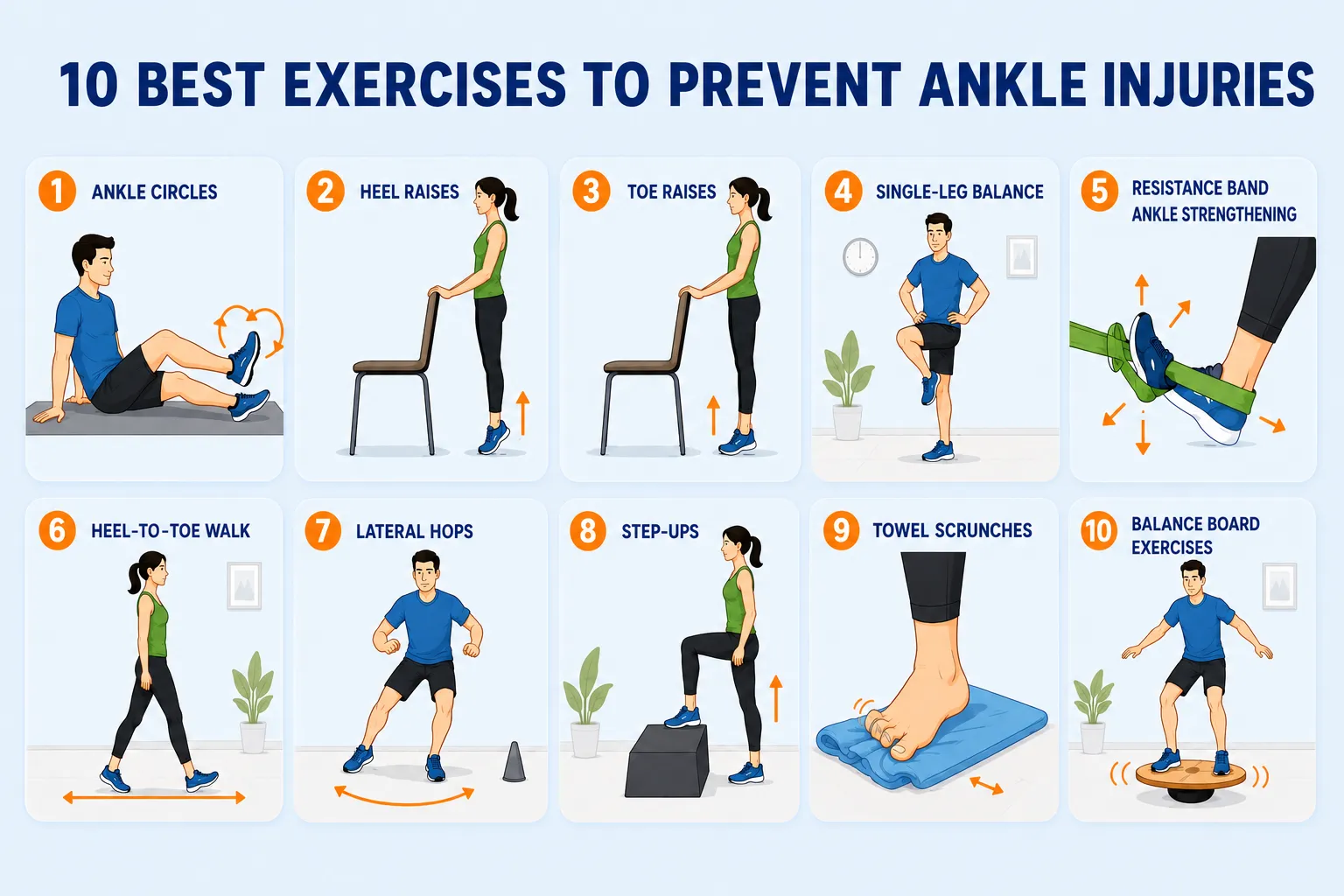
The right ankle exercises focus on improving strength, stability, flexibility, and control to support safer movement. Here are some of the best exercises to prevent ankle injuries:
1. Ankle Circles
Your ankles move in different directions throughout the day, and maintaining this movement is important for healthy joint function. Ankle circles involve slow rotations that help loosen stiffness and improve flexibility around the joint. This simple movement helps your ankle become more prepared for activities such as walking, running, or exercising. Regular mobility exercises can support smoother movement and reduce the chances of discomfort caused by tight or restricted joints.
2. Heel Raises (Calf Raises)
The calf muscles provide important support every time you stand, walk, climb stairs, or perform physical activities. Heel raises strengthen these muscles by improving their ability to support your body weight and absorb pressure during movement. Stronger calf muscles help create a more stable foundation for the ankle joint. Better lower leg strength can improve balance, reduce unnecessary stress on your ankles, and support safer everyday movements.
3. Toe Raises
A healthy ankle needs proper coordination between different muscle groups that control your foot and lower leg movements. Toe raises help activate the muscles at the front of your leg that are responsible for lifting and controlling your foot. Strengthening these muscles improves balance between the front and back of the ankle. This added control can help prevent weakness, improve walking stability, and support better overall ankle function.
4. Single-Leg Balance
Your ankle constantly makes small adjustments to keep your body steady, especially when walking on uneven surfaces or changing direction. Single-leg balance exercises improve this ability by training the muscles and nerves around the ankle to work together. Better balance improves your body’s awareness of movement and position, helping you react faster. This can lower the risk of sudden twists, falls, and repeated ankle ligament injuries.
5. Resistance Band Ankle Strengthening
Everyday movements require your ankle to move in multiple directions, not just forward and backward. Resistance band exercises help strengthen the muscles that control these different movements by adding gentle resistance. Improving strength in all directions gives the ankle better support and stability. These exercises are commonly used during recovery and injury prevention because they help rebuild confidence, control, and strength around the ankle joint.
6. Heel-to-Toe Walk
Good balance helps protect your ankles during walking, exercising, and other daily movements. Heel-to-toe walking helps improve balance by training your body to stay steady with each step. It strengthens the small muscles around the ankle that help maintain control and stability. Practicing this movement regularly can improve confidence while walking and help your ankles adjust better when moving on different surfaces.
7. Lateral Hops
Quick movements and sudden direction changes are common reasons behind ankle twists and sprains. Lateral hops help your ankles become stronger by improving balance, control, and landing stability. This movement is especially useful for people involved in sports or activities that require fast movements. Training your ankle to handle these changes safely can help reduce the risk of injuries and improve overall movement confidence.
8. Step-Ups
Your ankles, knees, and hips work together to support your body during everyday activities. Step-ups help strengthen these connected muscles by improving lower-body strength and balance. Stronger muscles allow pressure to be shared properly instead of placing too much stress on your ankle joint. Practicing step-ups can make regular activities like walking, climbing stairs, and exercising easier and safer.
9. Towel Scrunches
The small muscles in your feet play an important role in supporting your ankles and maintaining balance. Towel scrunches help activate these muscles by encouraging better foot strength and control. Stronger foot muscles provide extra support to the ankle during standing, walking, and physical activities. Improving this connection between your foot and ankle can help maintain better stability and reduce injury risk.
10. Balance Board Exercises
Your ankles need to stay stable even when the surface below your feet changes. Balance board exercises improve your ability to maintain control by strengthening the muscles that support the ankle joint. They also help your body react faster when balance changes suddenly. These exercises are commonly included in training and recovery programs because they support better stability and help prevent repeated ankle injuries.
How Often Should You Do These Exercises?
You can perform ankle-strengthening exercises around 3 to 5 times a week, depending on your current fitness level and ankle condition. Consistency is more important than intensity because your muscles, ligaments, and joints need gradual training to build better strength and stability. Spending a few minutes regularly on balance, mobility, and strengthening exercises can improve ankle control and reduce injury risk over time.
Avoid increasing difficulty too quickly, as excessive stress can lead to discomfort. Warming up before ankle exercises is also important as it prepares your muscles and joints for movement and helps reduce unnecessary strain. If you are recovering from a previous ankle injury, follow a routine recommended by a healthcare professional for safer results.
Common Mistakes to Avoid During Ankle Exercises
Performing ankle exercises correctly is important to improve strength and prevent unnecessary strain. Avoiding these mistakes can help you exercise safely and get better results:
- Increasing exercise intensity too quickly without allowing your ankle to adapt
- Ignoring pain or discomfort while continuing the same movements
- Performing exercises with poor balance, posture, or incorrect technique
- Skipping warm-ups before starting ankle-strengthening activities
- Focusing only on strength while ignoring flexibility and mobility exercises
If ankle discomfort continues despite proper exercise habits, getting evaluated at a joint care clinic can help identify underlying issues and guide appropriate treatment.
When Should You See a Doctor?
You should see a doctor if ankle pain, swelling, or difficulty with movement does not improve within 1 to 2 weeks despite rest and basic care. While minor discomfort can settle with proper exercises, persistent symptoms may indicate ligament injuries, joint problems, or other underlying conditions that need medical evaluation.
Get medical attention earlier if you cannot put weight on your ankle, notice severe swelling, experience repeated ankle twists, or feel instability while walking. Getting timely guidance from an orthopedic specialist in Chennai can help diagnose the problem and support proper recovery.
Final Word
Strong and stable ankles play an important role in supporting everyday movement, sports performance, and long-term joint health. Adding simple ankle exercises to your routine can help improve balance, flexibility, and strength while reducing the risk of future injuries. Understanding your body, avoiding common mistakes, and getting timely guidance from a joint pain specialist can make a significant difference in protecting your mobility.
If ankle pain, weakness, or recurring injuries continue to affect your daily activities, Dr. Kunal Patel can help identify the underlying cause and recommend the right treatment approach to support safer recovery and better movement.
FAQs
1. What are the best exercises to prevent ankle injuries?
Exercises that improve ankle strength, balance, flexibility, and stability can help reduce injury risk.
2. Can ankle exercises prevent sprains?
Yes, regular ankle strengthening and balance exercises can improve joint control and lower the chances of sprains.
3. How often should I do ankle strengthening exercises?
Ankle strengthening exercises can usually be performed 3 to 5 times a week based on your fitness level.
4. Are ankle exercises helpful after a previous injury?
Yes, guided ankle exercises can help rebuild strength, stability, and movement after recovery from an injury.
5. Why is balance training important for ankle injury prevention?
Balance training improves joint awareness and helps your ankle respond better to sudden movements.
6. Can weak ankles become stronger with exercise?
Yes, consistent strengthening exercises can improve ankle support, control, and overall function.
7. Should athletes do ankle exercises regularly?
Yes, athletes can benefit from ankle exercises to improve stability during running, jumping, and quick movements.
8. When should I worry about ankle pain during exercise?
Persistent pain, swelling, or instability during exercise may require a medical evaluation.
9. Which doctor treats ankle injuries in Chennai?
An orthopedic specialist can diagnose and treat ankle injuries, pain, and movement problems.
10. Who can help with recurring ankle injuries and joint problems?
Dr. Kunal Patel can help identify the cause of recurring ankle injuries and provide appropriate treatment guidance.